
Lee County Scheduled Versus Actual Release
A projected date is a calculation made before custody ends. It reflects the sentence, credit known to the custodian, and the rules that apply at that point. An actual release date and time record a completed event. The two facts are not interchangeable. A future value can move, while a past release must be supported by the custodian’s event record, release letter, or another affirmative source.
That distinction matters across Lee County’s systems. SWVRJA holds local and regional jail prisoners, VADOC handles state-responsible sentences, and the federal Bureau of Prisons handles people at USP Lee. Each custodian keeps its own dates. A Lee County court order sets the sentence or authorizes release, but the holding agency completes the physical release process. A court may act before the jail finishes paperwork, checks for detainers, and records the departure.
Release Date is the agency’s current expected date. Use “actual release” only after an official source confirms that custody ended.A pretrial detainee usually presents a different problem. There may be no fixed Lee County projected release date at all. Bond can be granted, changed, or revoked. A charge may be dismissed, and another hold can still prevent departure. The live SWVRJA locator only addresses current custody and does not publish a timetable. Court details can explain the legal event, while SWVRJA’s release entry supplies the actual exit time and disposition.
VADOC Lee County Release Date Field
The Virginia Department of Corrections calls its public field Release Date. That exact label should be preserved. For an incarcerated person with a future date, it functions as the presently computed or expected date. VADOC does not call it guaranteed. Its locator covers incarcerated people, probationers, parolees, people in local or regional jails under VADOC authority, institutional-hospital assignments, and Community Corrections Alternative Program participants.
The locator accepts either a seven-digit DOC ID or a name. A name search needs at least the first three letters of the first name and the complete last name. Optional location, race, gender, and age-range filters can narrow a common name. After accepting the disclaimer, compare candidates by DOC ID and other lawful identifiers. Then open the result and read both the location and Release Date. VADOC says the information is updated daily, yet it may be inaccurate or out of date.
- Determine whether the person is under VADOC authority rather than serving only a local SWVRJA sentence.
- Search by DOC ID when known, or use the required first-name letters and full last name.
- Open the correct result and copy the location plus the field labeled
Release Date. - Compare the expected date with the sentencing order and any known jail credit.
- After the date passes, confirm an actual release event instead of converting the old forecast into a completed fact.
The official VADOC Inmate & Supervisee Locator shows the public search path and its limits.
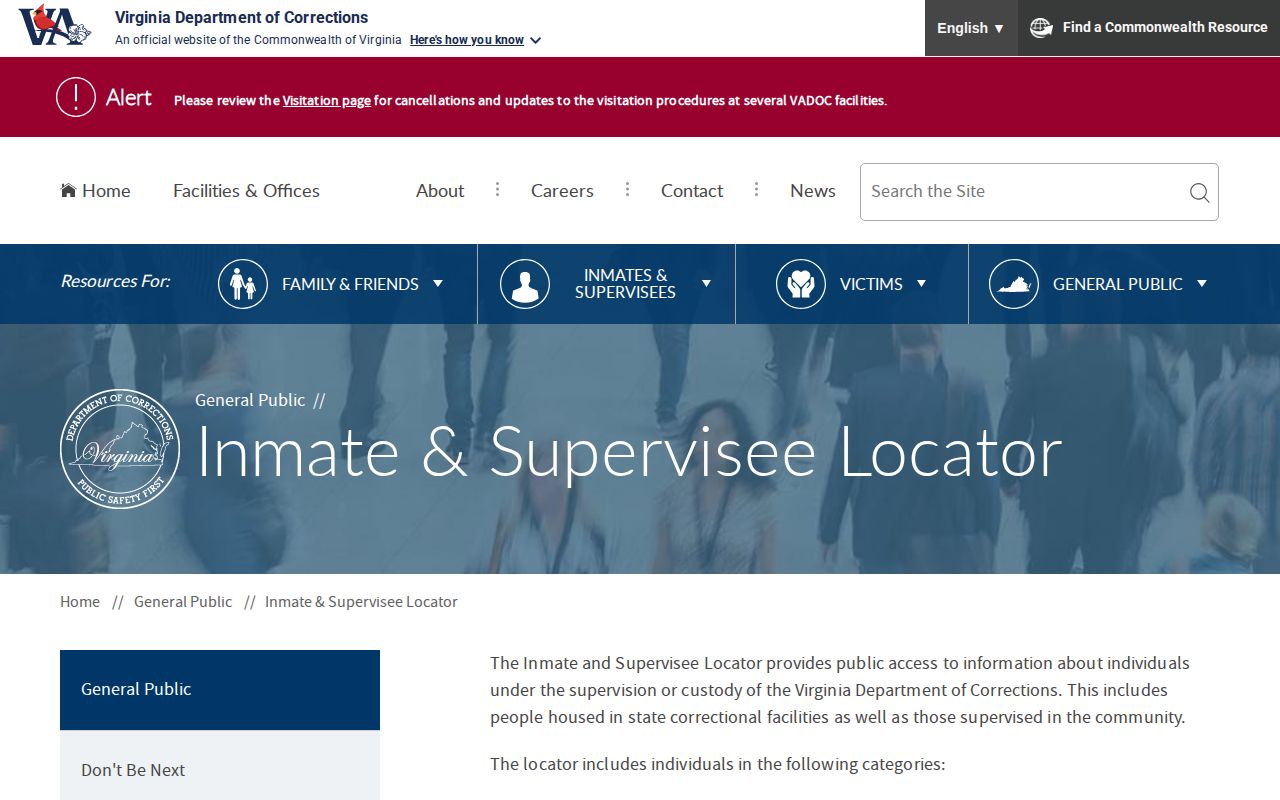
The captured locator makes the agency source easy to identify, but a screenshot taken before the listed day remains evidence of an expected date only. Full discharge creates another limit. A person released from prison onto probation or parole may remain visible with a district-office assignment. Someone discharged from both custody and supervision may no longer appear. The locator is not promised as a permanent historical archive. For an old Lee County discharge, seek the VADOC event or release record and consult the sentencing case.
Who Computes Lee County Release Dates?
Lee County sentences can be calculated by different custodians. This is the distinctive local issue behind the search. VADOC explains that local or state authorities determine the date based on sentence type and active time. A short sentence served within SWVRJA may be calculated locally. A state-responsible term may be computed by VADOC even while a person remains for a time in a regional jail.
The court imposes active and suspended terms. “Active” time is the part to be served now. “Suspended” time is not current confinement, although a later violation can bring some of it back into play. The custodian then applies valid jail credit and the correct sentence-credit framework. Qualifying pretrial confinement credit is governed by Virginia Code § 53.1-187. VADOC says its calculations can cover discretionary-parole eligibility, mandatory-parole release, good-time release, and earned-sentence-credit dates when those rules apply.
A Lee County judgment alone does not prove that VADOC controls the public date. Start with the current custodian. If SWVRJA holds the person on a local term, ask the authority which office calculates it. If the result shows a VADOC institution or state-responsible status, use VADOC. The Virginia Department of Corrections central office is at P.O. Box 26963, Richmond, VA 23261, with main number (804) 674-3000. Inmate time-computation concerns are routed through its Correspondence Unit/Court & Legal Section.
Note: A transfer from SWVRJA to VADOC ends one custody episode but does not mean the person was released into the Lee County community.
Lee County Earned Release Credits
Virginia uses more than one credit system. The offense date, offense category, and sentence type decide which system applies. For many felony offenses committed on or after January 1, 1995, earned sentence credits replaced ordinary discretionary parole. VADOC describes the standard ESC-1 range as zero to 4.5 days earned for each 30 days served, depending on classification, for the offenses listed in § 53.1-202.3(A).
At the maximum standard rate, 30 served days plus 4.5 credit days satisfy 34.5 sentence days. That arithmetic supports the familiar description that a person may serve about 85 percent. It is not a fixed promise. A lower earning class, disciplinary action, an ineligible offense, mixed sentences, or a corrected order can produce a different result.
Eligible ESC-2 sentences under § 53.1-202.3(B) can earn from zero to 15 days per 30 served, based on class. The statute has offense-based limits and has changed, so current text controls. Older Good Conduct Allowance cases generally involve felony offenses before January 1, 1995 and certain misdemeanor sentences before July 1, 2008. VADOC lists GCA rates from zero to 30 days per 30 served. Those older sentences are also central to ordinary parole eligibility. The VADOC time-computation resource describes these credit systems and calculation inputs.
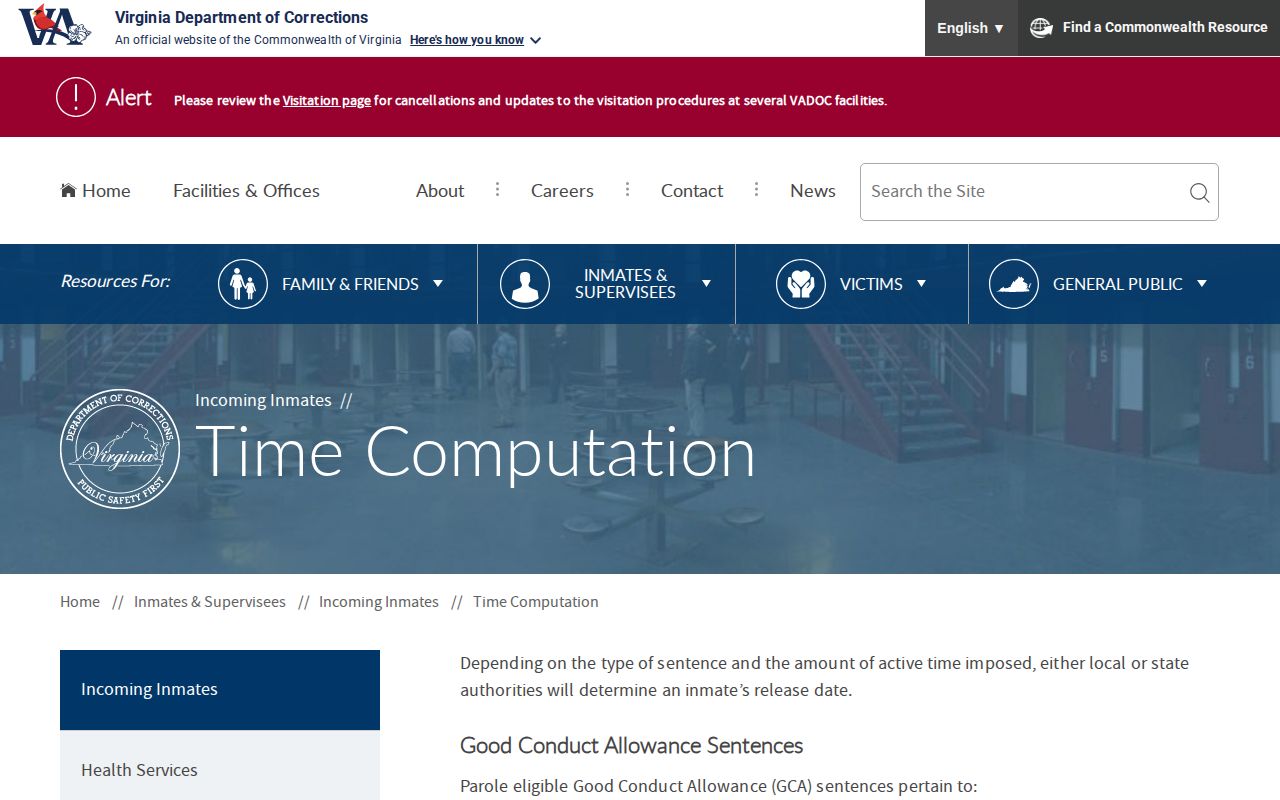
The captured state resource reinforces why one percentage cannot replace a sentence-specific computation under the current statute.
- Earned sentence credit
- Time credited toward service of an eligible sentence based on the governing class and statutory rules.
- Good Conduct Allowance
- An older credit framework that applies to defined sentence categories and offense dates.
- Parole eligibility date
- The first point when an eligible case may be considered, not a promised release day.
- Discharge
- The legal end of custody or supervision as recorded by the responsible agency.
Why Lee County Release Dates Move
A computed date changes when one of its inputs changes. VADOC identifies pre-VADOC jail time, total sentence, sentence type, earning class, disciplinary offenses, and other events as relevant factors. Court action can amend or vacate an order. A jail-credit correction can add or remove qualifying credit. Consecutive sentences may extend the combined active term, while mixed credit systems can limit the benefit expected from one count.
| Change | Effect on the date | Best confirmation |
|---|---|---|
| Jail-credit correction | Qualifying pretrial time is added, removed, or reassigned. | Court order and calculating custodian |
| Earning-class change | Credits accumulate at a different rate. | VADOC time computation |
| Disciplinary offense | Credit earning or existing credit may be affected under applicable rules. | Custodian record |
| Amended sentence | Active, suspended, concurrent, or consecutive terms change. | Entered court order |
| Parole decision | An eligible person may receive or be denied conditional release. | Virginia Parole Board and VADOC |
| Detainer or hold | The sentence may end, but another agency may take custody. | Release disposition and receiving agency |
A detainer deserves care. It is a request or authority for another agency to hold or receive a person. It may change the destination without changing when the current sentence is satisfied. “Released to another agency” is often a transfer, not freedom from custody. The release entry should identify the disposition or receiving agency before the event is described.
Lee County Jail Release Dates
SWVRJA’s public current-inmate access point opens an authority-wide JailTracker. It does not advertise a projected-release field, release calendar, or historical archive. A negative result does not prove release. A person may have moved among Duffield, Abingdon, Haysi, or Tazewell, entered VADOC custody, gone to another jurisdiction, or been absent because of data lag.
For a local sentence, compare the Lee General District Court or Lee Circuit Court record with SWVRJA’s custody record. General District Court handles misdemeanors and preliminary felony proceedings. Circuit Court handles felony trials and sentencing. A felony certification or transfer in the first court is not the final disposition. The case details may show the jail term, suspended part, probation, or time served, yet they usually do not record the exact moment the person walked out.
When public sources do not settle the matter, request the cumulative booking-and-release entry for the exact confinement episode. Ask for the actual release date and time, release disposition or destination, booking number, and authorizing court or agency. SWVRJA’s FOIA contact is Melissa White, P.O. Box 279, Meadowview, VA 24361, (276) 739-3520. No flat fee is published, so request an estimate. Duffield can be reached at (276) 690-9550; no public counter hours are stated, so call first.
Note: A court may order release before SWVRJA records the completed exit, so preserve both times when the legal and physical events differ.
Confirm Lee County Actual Release
When the expected day arrives, check the current custodian again. A VADOC result may shift from an institution to a probation or parole district, showing release from secure confinement while supervision continues. It may move to another institution. If the person has fully discharged, the public result may disappear. None of those possibilities should be guessed from yesterday’s forecast.
Use an affirmative post-event source. For SWVRJA, obtain the cumulative booking-and-release entry or a VINE custody-change event, backed by the court when needed. For VADOC, seek the release event or letter and note any district-office assignment. Virginia VINE covers local and regional jails, while VADOC uses a separate state-custody notification program for eligible victims. The Lee County VINELink inmate search explains the local notification boundary. For the broader custody and records path, use the Lee County released-inmate search.
Keep the language exact. “Expected release date” fits a future calculation. “Parole granted” records a board decision, not the gate event. “Out of SWVRJA custody” says only that one agency no longer holds the person. “Actual release date and time” belongs to a completed event. This vocabulary protects the difference between a forecast, a transfer, community supervision, and full discharge.