
Lee County VINELink Coverage
Virginia Victim Information and Notification Everyday, or Virginia VINE, covers all local and regional jails in the Commonwealth. SWVRJA confirms its participation and states that users may search custody status by telephone or online. The service can also send telephone and email notices when a selected person’s status changes. For Lee County arrests held at Duffield or another SWVRJA facility, VINE is the official notification layer attached to the regional jail system.
Coverage follows the custodian. It does not follow the county name alone. A Lee County arrestee can appear under SWVRJA even when housed outside the county. A person at USP Lee is in federal Bureau of Prisons custody and is not covered by local VINE. A state-responsible person transferred to VADOC enters a separate state-custody notification framework. VINE is therefore strong for one SWVRJA episode but should never be described as a combined jail, state-prison, and federal history.
Run a Lee County VINELink Search
Start with the specific person and expected reporting agency. Use a full name and any lawful identifier the live form offers. A booking number, age range, facility, or other case-linked fact helps distinguish candidates. The interface is application-driven, so button text may change. Follow the current labels rather than expecting a fixed screen.
- Open VINELink and choose Virginia as the state.
- Select the current offender or custody-search option, then enter the person’s name or available ID.
- Narrow by agency, facility, or age only when the live interface offers those fields and the detail is known.
- Compare possible matches with more than the name. Look for SWVRJA as the reporting jail system for a local Lee County booking.
- Open the correct record and read the displayed custody status, agency, and event information together.
- If no record appears, call Virginia VINE or SWVRJA. A no-result is not proof of release.
The Lee County released inmate search adds court, VADOC, BOP, and records-request paths when the person’s custodian is uncertain. VINELink itself should remain a specific-person status check, not a substitute for every official system.
Lee County VINELink Search Screen
The official VINELink person-search interface provides the entry point for choosing Virginia, locating a person, opening a record, and reaching notification options.
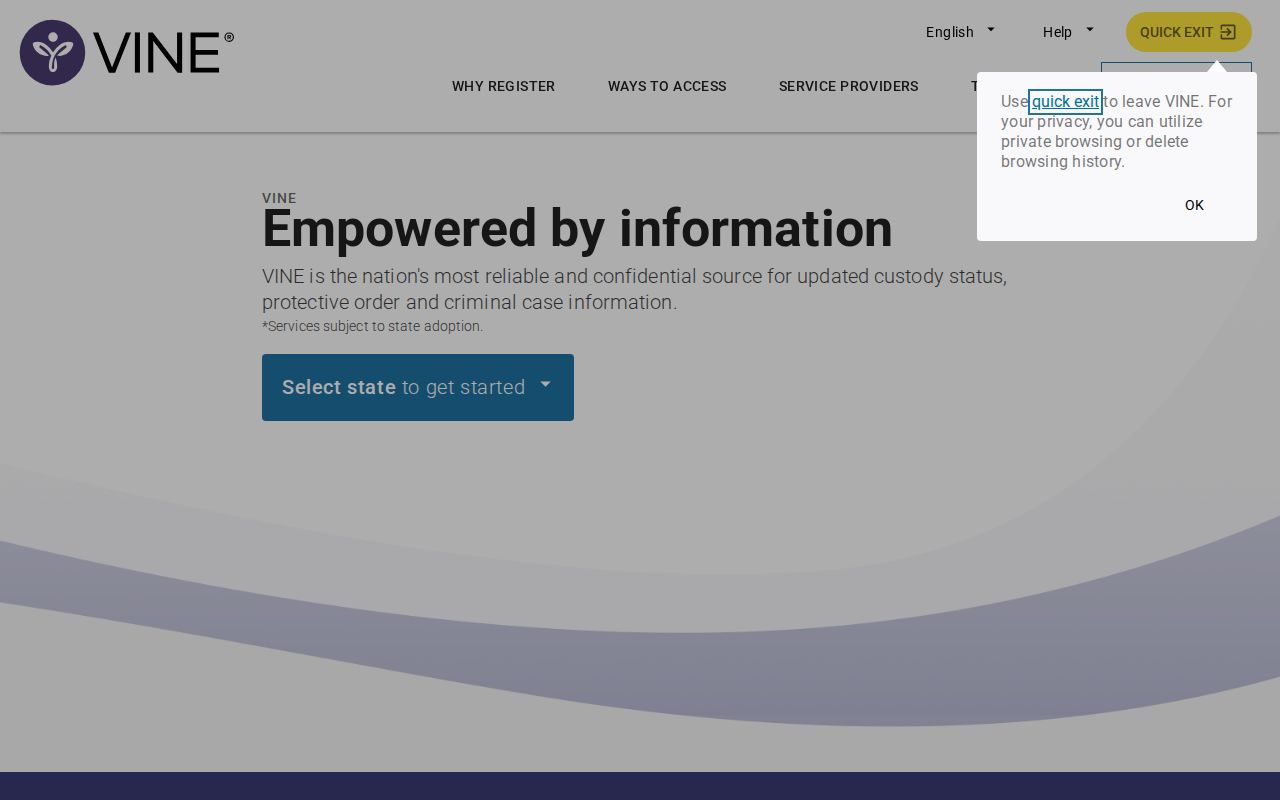
The image identifies the correct national interface, but live labels and result details can change. Always read the active screen and avoid using a sample result as a permanent description of every SWVRJA record.
Note: Do not expose a registrant’s phone number, email address, account details, confirmation code, or PIN when saving a status record.
Read Lee County VINELink Results
A VINELink result should be quoted with the label shown on the live screen. Virginia’s official sources support custody searching, status notifications, and local-jail coverage, but they do not promise one fixed released-result layout. The useful fields answer which person, which agency, and what custody event the service currently reports.
| VINELink detail | How to interpret it |
|---|---|
| Name or offender identity | Identifies the selected person, subject to a careful match with other known facts. |
| Reporting agency or facility | Shows which jail system supplied the status; SWVRJA is the key local agency. |
| Custody status | States the current status language reported for that agency episode. |
| Event or status-change detail | May help distinguish release, transfer, or another reported change when displayed. |
| Notification action | Opens registration for the selected record and available delivery channels. |
A released or out-of-custody result supports departure from the reporting jail episode. It does not always mean release into the community. Check for transfer language and then search the receiving system. A SWVRJA departure followed by a VADOC institution result is a state transfer. A court order or SWVRJA release entry can add the exact legal basis, actual time, and destination.
Current custody and historical release are also different uses. VINELink is built to report a participating agency’s status and send notice of a change. SWVRJA’s cumulative booking and release entry is the better long-term record because it can identify the completed event and disposition. Virginia’s jail retention schedule keeps cumulative release records longer than the full inmate file, but retention does not make every internal field public. Ask for the narrow event record when a VINE screen no longer supplies enough detail.
Set Lee County Release Alerts
Registration begins from the correct person record. Confirm the person and reporting agency first, because the alert attaches to that custody episode. SWVRJA expressly documents telephone and email notification. VINELink’s current interface may also offer text, app, or account options, but use only the channels actually shown during registration.
- Open the matched SWVRJA person record and choose Get Notified, Register, or the current equivalent.
- Select an available delivery method. Enter only contact details controlled by the registrant.
- Complete the confirmation method shown, such as an email link, verification code, account step, or telephone PIN.
- For a phone flow that asks for a PIN, choose one that is not easy for another person to guess. The automated call may require it to confirm receipt and stop repeat calls.
- Save the registration information, check spam or caller-blocking settings, and confirm that notifications remain enabled.
- Update the registered destination when a phone number or email address changes.
Virginia VINE assistance is available at (800) 467-4943. SWVRJA also directs users to that number for status and notification help. An alert is a supplement. When an answer is urgent or legally significant, call the current custodian and check the court rather than waiting for a message.
Lee County VINE and NAAVI
Virginia maintains two notification systems that cannot be merged. VINE covers every Virginia local or regional jail, including SWVRJA. Notification and Assistance for Victim Inclusion, known as NAAVI, is VADOC’s post-sentencing notification service for qualifying victims and immediate family in the state-custody context. VADOC states that NAAVI is not connected to local-jail VINE and does not send notices about probationers or parolees.
A move from SWVRJA to VADOC can therefore require a new registration. The local VINE enrollment does not automatically become a state-custody NAAVI enrollment. Eligible registrants may contact VADOC Victim Services at (804) 674-3243 or (800) 560-4292, Monday through Friday from 8:30 a.m. to 5 p.m., or victimservices@vadoc.virginia.gov. Eligibility limits apply.
| Custody lane | Notification or search route | Key limit |
|---|---|---|
| SWVRJA local or regional jail | Virginia VINE and VINELink | Tracks the reporting jail episode, not a permanent archive |
| VADOC state custody | NAAVI for eligible victims; VADOC locator for public status | Separate registration; NAAVI does not cover probationers or parolees |
| USP Lee or other federal custody | BOP locator and qualifying federal notification channel | Not covered by Virginia VINE |
Note: A transfer may end the SWVRJA VINE episode while confinement continues under VADOC, so register with the correct system for the new custodian.
Lee County VINELink Search Limits
VINE data can lag the underlying custody event, and a current interface can change fields or status wording. A no-result may stem from spelling, agency selection, processing delay, transfer, or system coverage. It does not prove release. Call VINE or SWVRJA when a known local booking cannot be found. For the strongest historical proof, request SWVRJA’s cumulative booking and release entry with actual date, time, disposition, and receiving agency.
VINELink also does not provide the legal meaning of every departure. A court record may show bond, dismissal, time served, or a sentence. A receiving system may show that custody continued. VADOC’s Release Date on an incarcerated result is a future or currently computed date, not proof of an actual release. A district-office location indicates community supervision in that current result, not full discharge.
Federal and immigration systems remain separate. BOP’s Released or Not in BOP Custody result confirms only the end of BOP custody. ICE’s locator is current-location oriented and is not a release history. Use those systems only when the known facts point to those custodians.
A registry is separate as well. The Virginia State Police sex-offender registry covers only people who have a legal duty to register. Presence in that registry does not provide the SWVRJA release time, and absence does not prove custody. Keep registry information confined to its own legal purpose. For a Lee County VINE question, the reporting jail, custody event, court record, and any receiving system remain the sources that can explain what happened.
Confirm Lee County VINE Events
A VINE alert is strong corroboration that the reporting agency recorded a change. The custodian’s release entry remains the best source for the physical event. The court order is strongest for the legal authorization. A receiving-system locator establishes whether custody continued elsewhere. Preserve the time each source was retrieved, since a court action, SWVRJA update, and VINE message can occur at different times without contradicting one another.
Use careful release terms. Actual release date and time means a completed custodian event. Transfer means another agency assumed custody. Out of SWVRJA custody states only the boundary the evidence proves. Discharge means the sentence or supervision legally ended. This discipline prevents a local VINE alert from being stretched into a claim about freedom from every form of custody or supervision.
When sources differ, keep both timestamps. A Lee court can authorize release before SWVRJA completes identification, hold checks, property return, and departure processing. VINE can report after the jail sends its update. A receiving system can post later still. State that the court ordered release at one time and the custodian recorded the event at another when both are known. That phrasing preserves the legal action and the physical custody event without treating a routine reporting delay as a contradiction.
- Custody status
- The reporting agency’s current description of whether it holds the person.
- Release event
- A recorded departure from that custodian under lawful authority.
- Transfer
- A change of custodian rather than release into the community.
- Notification
- An alert about a reported status change, not a certified copy of the underlying record.